In 2026, social media has become a normal part of how businesses grow and connect with people. It is frequently the first place where people learn about a brand.
It is important to note that steady growth does not come from posting randomly. When you plan your content, everything becomes more organised and purposeful. A social media content calendar gives you structure and keeps your content organised.
It removes the daily stress of thinking about ideas at the last minute. Whether you are a business owner, marketer or creator, having a proper plan makes social media feel more manageable and much more productive.
What is a social media content calendar
A social media content calendar is a document or tool that plans and organises your social media posts in advance. It includes details such as:
- Posting date and time
- Platforms such as Instagram, LinkedIn, YouTube, Facebook or X
- Content type such as video, image, carousel or text
- Caption and hashtags
- Visual assets
- Target audience
- Purpose of the post
Instead of deciding what to post at the last minute, you plan your content weeks or months in advance.
This does not mean your content becomes rigid. You can still adjust based on trends, news or performance. But your foundation remains organised.
Here is an example:
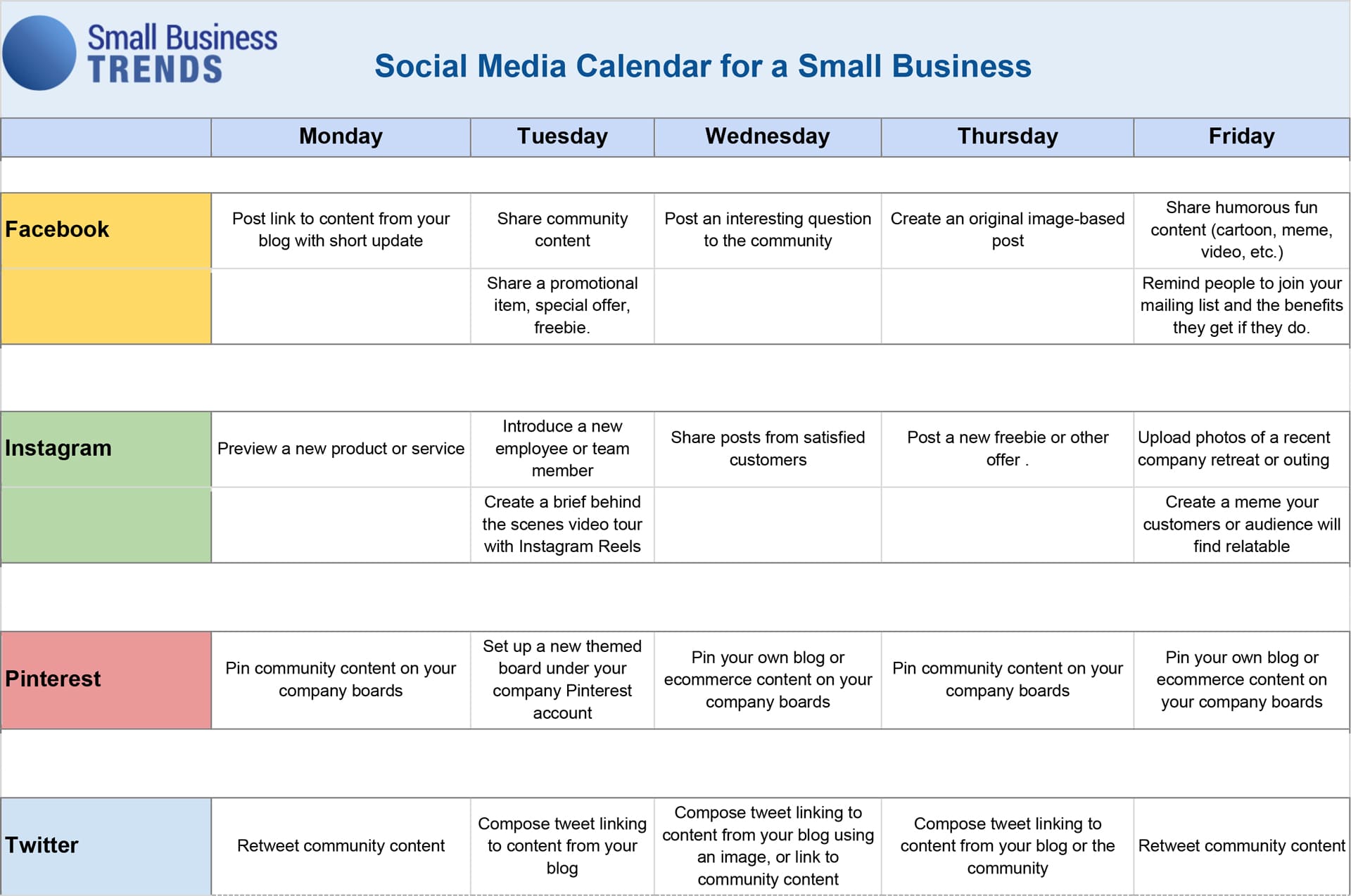
This example from Small Business Trends outlines a simple weekly social media plan to help businesses stay organised and consistent.
Types of content you should include in 2026
Social media growth becomes easier when you use a variety of posts. Different content helps you reach different people. Each post contributes differently, so keeping a balance improves your results.
1. Educational content
This type of content is important as it gives real benefit to your audience. When you help them understand or solve something, they are more likely to follow you. Examples include:
- How to guides
- Practical tips
- Tutorials and explanations
2. Personal and behind-the-scenes content
This makes your brand feel human and relatable as sharing your journey, experiences or daily process helps people connect with you on a deeper level.
3. Authority content
This makes your audience see you as knowledgeable and reliable. Sharing what you have learned strengthens their confidence in you.
4. Engagement content
This encourages interaction and strengthens your community. You can use:
- Questions
- Polls
- Opinion-based posts
5. Promotional content
This is important for conversions, but it should be used carefully. Focus on showing value and relevance instead of constantly selling.
Why you should plan a social media calendar ahead of time
There is a lot of competition on social media today so only social media accounts which are consistent stay visible. Platforms favour those which post regularly and share meaningful content. Random posting often leads to slow growth. A social media calendar brings structure to your work and helps you stay focused.
Here are the key benefits of planning a social media calendar ahead of time.
1. Consistency builds trust
Consistency matters way more than you’d think. Show up regularly and your audience actually starts looking for your content. They recognise you. That familiarity builds trust. And trust is what turns random followers into people who actually care about what you post.
2. Saves time and reduces stress
Without a calendar, you spend time every day deciding what to post. This creates stress and reduces efficiency.
With a calendar, you plan content in advance and batch create posts. This saves hours every week.
You work smarter instead of harder.
3. Improves content quality
You know what happens when you plan your content ahead?
- You stop posting in a panic at the last minute.
- Give yourself more time to think.
- Research topics worth covering.
- Make images that don’t look like you created them in five minutes.
- Write captions people might actually read all the way through.
When you plan, you create things that matter. Your audience notices the difference. They engage more and they trust you more. That’s what good content does. So, take the time to plan and content that delivers real value and creates a stronger impact.
4. Aligns content with business goals
Every post should have a purpose. That purpose could be:
- Brand awareness
- Website traffic
- Lead generation
- Product promotion
- Community building
A calendar ensures your content supports your business objectives.
5. Helps you track performance
Planning ahead makes it way easier to track what’s working. You can look back and spot the patterns and identify which posts got traction and which ones did not.
That matters because you start to understand your audience. What they care about. What they ignore. You are not guessing anymore.
The more you do this, the smarter your content gets. You drop what doesn’t work and double down on what does. Your results improve because you’re actually paying attention.
Stay in the know
Keep on top of how the latest marketing, SEO, branding and design tips can be used to
grow your business – delivered straight to your inbox.


Step-by-step guide to creating a social media calendar
Let us break down the process into simple steps.
Step 1: Define your goals
You must know your goals before planning your social media calendar. Your goals help you pick the right content and communication style.
Ask yourself:
- Do you want more followers
- Do you want more website visitors
- Do you want more leads
- Do you want to build brand authority
- Do you want to increase sales
Each goal requires a different content strategy.
For example:
- Want people to know your brand exists? Then post content that teaches them something or makes them laugh.
- Trying to actually sell? Then show your products and prove why people should trust you.
When you know what you’re after, it’s way easier to figure out what to post.
Step 2: Understand your target audience
Before creating content, identify who you want to reach. This makes your social media efforts more effective.
To understand your target audience, you can ask them questions like:
- Who is your ideal customer
- What problems do they face
- What content do they consume
- Which platforms do they use
- What motivates them
For example:
- A business audience responds well to LinkedIn educational posts.
- A younger audience may engage more on Instagram and YouTube.
Understanding your audience improves engagement.
Step 3: Choose the right platforms
You do not need to be on every platform. Focus on platforms where your audience is active.
Common platforms in 2026 include:
- Instagram for visual and video content
- LinkedIn for professional and business content
- YouTube for long and short video content
- Facebook for community and local businesses
- X for updates and discussions
Choose two or three platforms and focus on them. Quality is better than quantity.
Step 4: Decide your content pillars
Content pillars are the main topics your brand focuses on. Most businesses use four to five pillars.
Examples include:
- Educational content
- Tips and advice
- Behind the scenes
- Customer stories
- Product or service content
- Industry insights
Content pillars help maintain consistency and clarity. Your audience understands what to expect.
Step 5: Decide posting frequency
Post as often as you can actually handle. Think about your time, what platforms you’re on, all that. Avoid posting excessively every day for two weeks only to stop completely as you feel overwhelmed.
Here is what works for most people:
- Instagram: 3-5 times a week
- LinkedIn: 2-4 times a week
- YouTube: 1-2 videos a week
- Facebook: 3-5 times a week
Honestly, post twice a week and actually stick to it. That’s miles better than trying five times for a bit and then stopping. Start small. You can do more later when it’s a habit.
Step 6: Create a monthly content plan
Decide your daily content in advance to avoid last-minute planning. A weekly structure helps you organise your content and maintain variety. Post as per your pace or posting frequency.
For example:
- Monday: Educational post
- Tuesday: Tips or advice
- Wednesday: Behind the scenes
- Thursday: Industry insight
- Friday: Engagement post
- Saturday: Promotional or brand post
- Sunday: Optional or rest day
This structure keeps your content balanced.
Step 7: Plan content formats
Using different content formats helps keep your content interesting and reach more people.
You can use formats such as:
- Videos
- Images
- Carousels
- Text posts
- Infographics
In 2026, video content performs best, especially short videos. They improve reach and engagement.
Step 8: Write captions and prepare visuals
Preparing captions in advance helps you stay organised and consistent. It makes posting easier and improves overall content quality.
Good captions should:
- Provide value
- Be clear and simple
- Encourage engagement
- Include relevant keywords
Along with captions, prepare your visuals in advance. Ready visuals make posting faster and easier.
Step 9: Use a content calendar tool
You can plan your social media calendar using basic or advanced tools. Select what works best for you.
Simple tools include:
- Excel
- Google Sheets
Advanced tools include:
- Notion
- Hootsuite
- Buffer
- Later
Choose a tool that suits your workflow and makes planning simple. Even a spreadsheet works well.
Step 10: Schedule and automate posts
Schedule your content ahead and you won’t be stuck posting manually every single day. Plan it once, set it to go live automatically and your job is done.
Most platforms schedule posts. It is easy to organise your posts and get them out when you need them without lifting a finger.
The real win? You’re not constantly stressing about what to post today. You can actually focus on the stuff that matters, better content, talking to your audience, working out what’s performing. The day-to-day posting just handles itself.
Example of a simple social media calendar structure
Your calendar should include:
- Date
- Platform
- Content topic
- Content type
- Caption
- Visual status
- Posting status
- Goal
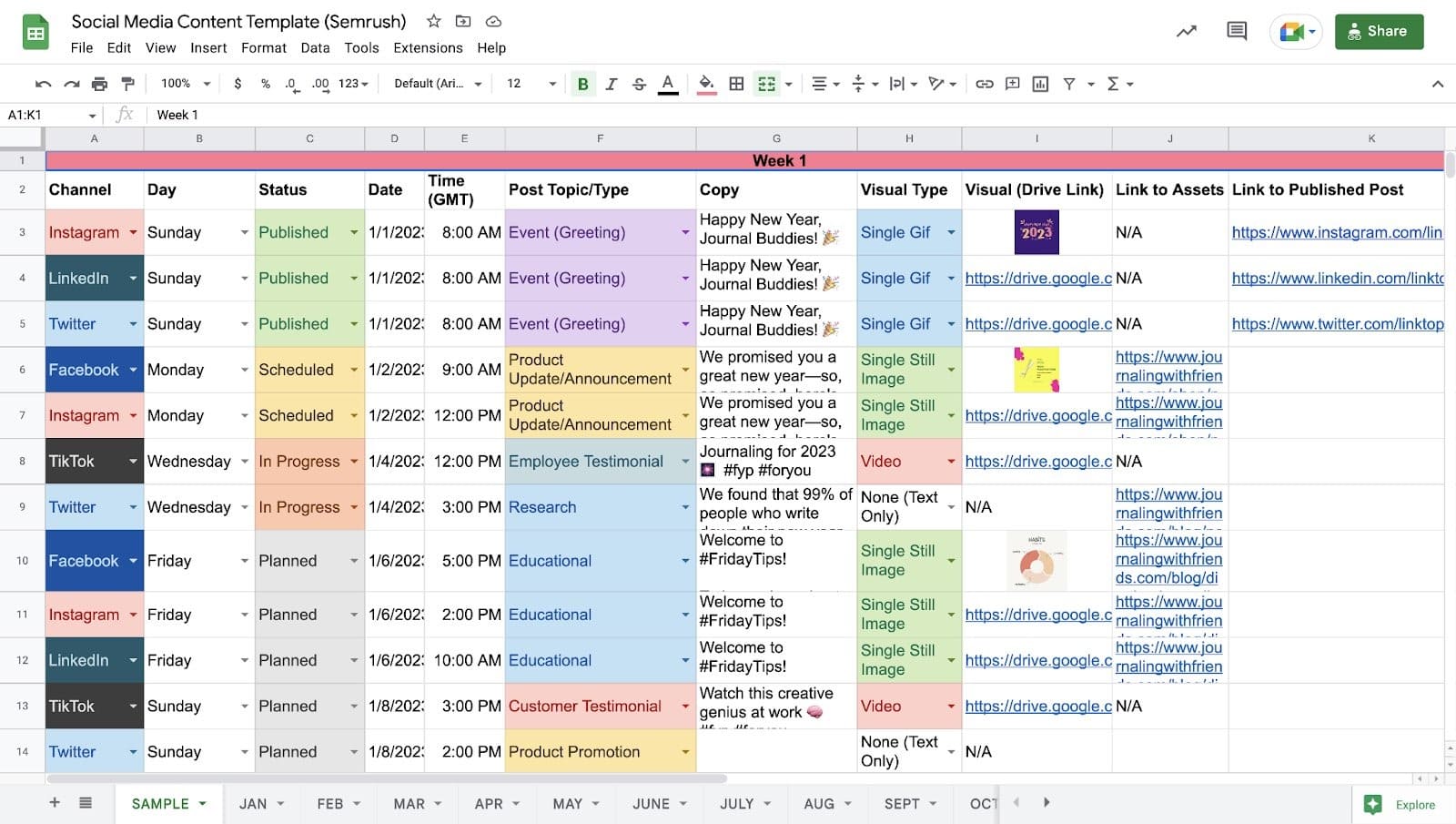
This example from Semrush highlights how businesses can organise post topics, visuals, links, and publishing status in a single dashboard.
Common mistakes to avoid
A social media content calendar works only when it is used with clear thinking and consistency. Many creators and businesses face problems because of small mistakes that can be avoided. Fixing them early helps improve growth and engagement.
Posting without a clear goal
- Focusing too much on selling instead of helping
- Ignoring performance data and audience response
- Posting regularly for a short time and then stopping
- Copying others without adding your own perspective
- Creating content without understanding your audience
This makes it easier to stay active and build credibility with your audience.
How to measure success
Regular performance checks help you understand how your content is performing. This makes it easier to improve your strategy using actual results. Pay attention to these important metrics:
- Reach: Shows how many people see your posts.
- Engagement: It tells you if anyone actually cares. Likes, comments, shares show you what’s landing and what’s not.
- Follower growth: Are you going up or down? Track it over time, not just week to week.
- Website clicks: Clicks matter if you’re trying to get people off social and onto your site. See if your content’s persuasive enough.
- Leads: This is where it counts. People interested enough to give you their details or reach out.
Every platform’s got analytics. Check them weekly, work out what’s doing well and give people more of that. Stop doing what doesn’t work.
How social media calendars improve SEO
Social platforms help expand your reach and guide potential customers to your website. Consistent and valuable posts improve brand recall and strengthen how people view your authority.
Some of the key benefits include:
- More visitors coming to your website through your social profiles
- Greater brand recognition among your audience
- Improved trust and professional reputation
- More opportunities for other websites to mention and link to you
Consistent posting keeps your brand active, visible and easier for people to remember.
Social media trends in 2026 you should include in your calendar
Knowing what is trending on social media helps your content calendar perform better. Platforms keep improving and your audiences change their behaviour accordingly. Post what’s actually trending and watch more people engage with it.
Put these in your calendar to improve your results in 2026:
- Short videos get seen more: They perform better than almost anything else right now.
- Educational posts make people trust you: Teach people things that actually help them. They will remember you for it and keep coming back.
- Drop the corporate act: Nobody likes that polished, fake marketing voice. Just sound like yourself.
- Talk to your audience properly: Ask your audience questions and reply when they comment. Show people you actually care, not that you’re just chasing follower counts.
Instagram and TikTok are search engines now. People look for things there just like they would on Google. So use normal words they’d actually type.
A social media content calendar is the key to staying organised and consistent with your posts. You are no longer waiting until the eleventh hour to make a decision as you already know what to post and when. This will ease your burden and stress each day. It also keeps you focused on your goals and prevents random posting.
If you struggle with writing a social media strategy, developing a content calendar or need someone to manage your various platforms, contact us today. We help you create an organised plan that will help you achieve your objectives.