Search results don’t stand still for long, but every so often, Google rolls out an update that causes a bit more disruption than usual. The December 2025 core update was one of those moments. It was the final major update of the year and finished rolling out on 29 December 2025.
If you spotted changes in visibility, rankings or traffic around mid to late December, you were not alone.
Websites in many industries were affected, including media outlets, e-commerce brands, professional services and local businesses. In this blog, we’ll look at what changed, what it means for website owners, and how to approach SEO moving into 2026.
Let’s dig into the December core update and focus on the key takeaways.
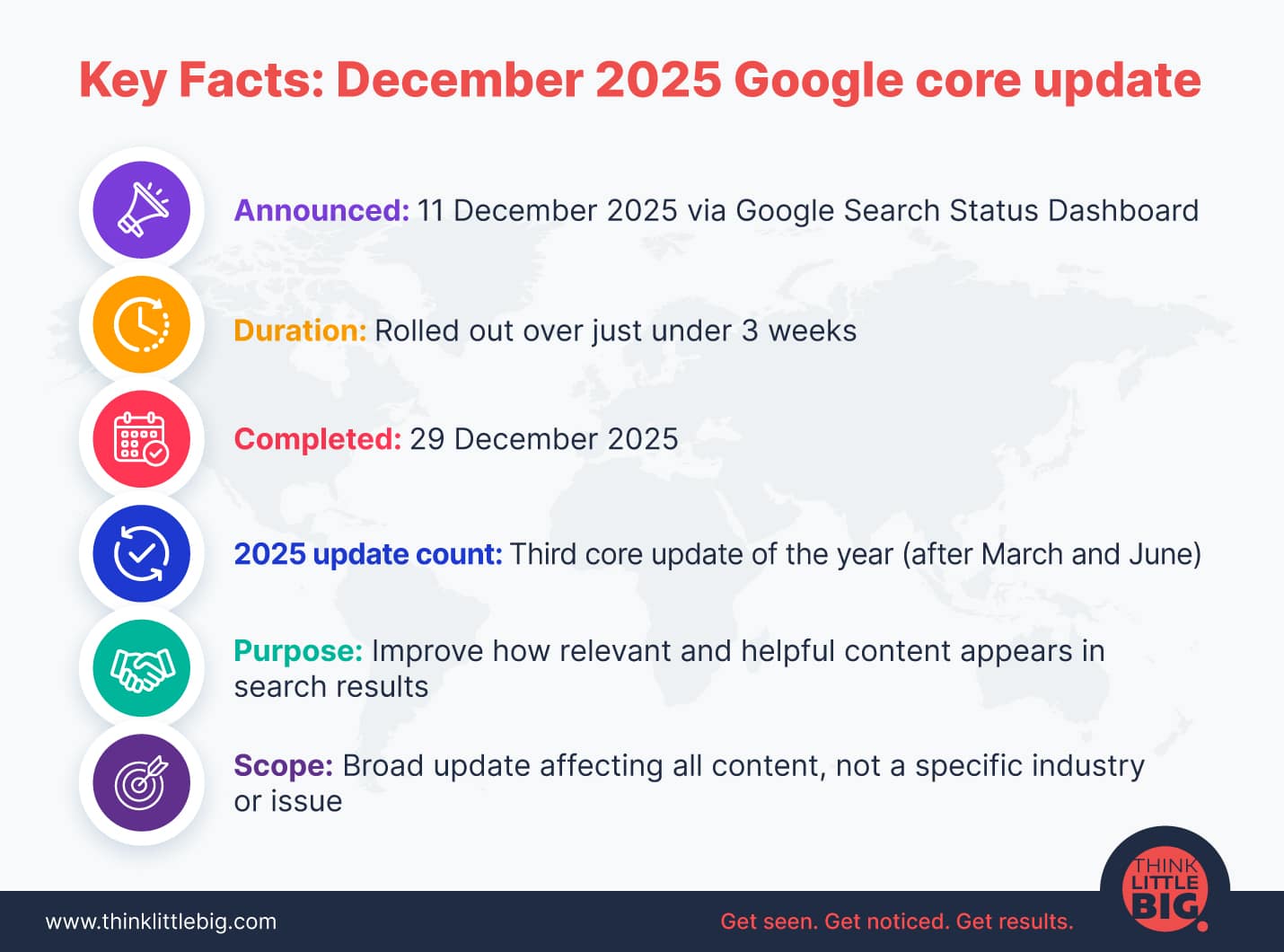
Key facts about the December 2025 Core Update
To understand the impact, it helps to be clear on what this update involved.
- Google announced the December 2025 core update on 11 December 2025 through its Search Status Dashboard.
- The rollout completed on 29 December 2025 and lasted just under three weeks.
- It marked the third core update released during 2025, following earlier updates in March and June.
- Google described it as a routine update aimed at improving how relevant and satisfying content is shown in search results.
- As with previous core updates, it was broad in nature. It did not target a specific problem or industry, but instead adjusted how Google’s core ranking systems assess content overall.
Because these updates focus on comparison rather than penalties, ranking changes can happen even when sites follow best practices. Content is simply re-evaluated against other pages competing for the same searches.
What you need to know about Google algorithm changes
Before exploring what changed in December, it helps to understand how Google approaches algorithm updates more generally.
Google regularly makes small improvements to its search systems. Most are not announced, but over time they influence how rankings shift and settle.
Two days before the December core update was released, Google updated its documentation to emphasise this continuous evolution — meaning improvements don’t always wait for a named rollout to take effect.
Core updates aren’t penalties
A crucial point to bear in mind: core updates are not manual penalties. There is no specific “rule” that has been broken when rankings shift. Rather, what changes is how Google evaluates content quality, relevance, user satisfaction and topical authority across the board.
This means:
A drop in ranking isn’t a “penalty” in the punitive sense.
It often reflects that other pages are now considered more relevant or valuable for a given query.
Recovery doesn’t happen through quick tweaks but by raising the overall quality and relevance of your content.
This shift from rule-based to relative content assessment has been a long-term trend. Google’s own guidelines for core updates now encourage site owners to improve their content continuously rather than focus solely on the timing of updates.
What actually changed (and what didn’t)
What changed
According to early industry analysis and aggregated data, the December core update:
- Reassessed how content aligns with user intent, favouring pages that deeply understand and address what searchers are looking for.
- Google continued to favour content that genuinely helps users, rather than pages focused purely on keywords.
- Greater importance was placed on expertise, authority and trust, rewarding sites that clearly know their subject.
- Pages sitting in the middle of search results saw the most movement, suggesting results were rearranged rather than removed entirely.
- Impacted sites were noticeably producing thin, templated or low-value content more visibly than those with comprehensive, curated content.
What didn’t change
Despite the noticeable movement, certain fundamentals stayed consistent:
- The update was not a targeted penalty, and no new manual actions were introduced.
- Page experience factors, links, mobile responsiveness and other long-standing ranking influences remained part of the broader algorithm.
- Core updates rarely introduce completely novel ranking factors; instead, they adjust how existing signals are weighted in context.
In short, the December core update reinforced existing SEO principles — but with a renewed emphasis on user value and content depth.
Observed patterns across SERPs
As the update rolled out through December, several trends emerged in the way search engine results pages (SERPs) behaved.
1. Volatility in rankings increased
SEO tracking tools and industry chatter showed notable spikes in volatility throughout the rollout, particularly around mid-December and just before the update finished. This suggests Google was testing and refining adjustments as data came in.
2. News and high-velocity content saw dramatic movement
Certain categories, especially news and high-frequency publishing sites, saw large drops in visibility. Some major news publishers experienced up to 70% loss in visibility in select markets.
For small businesses and service providers, this highlights a key point: not all rankings are equally stable, especially in environments where content quality varies widely between publishers.
3. Improved performance for genuinely helpful content
Sites that clearly answered user questions, provided thorough insights, and incorporated expert perspectives tended to show stronger resilience or even improvement post-update.
Collectively, these patterns underscore that Google is not just scanning pages for keywords, but trying to understand how well content solves searchers’ needs.
What this means for website owners
For business owners and marketing leads, the December core update serves as both a wake-up call and an opportunity. Here’s how it affects you:
1. Rankings can change even if you haven’t done anything
If you did not update your site but still noticed changes in traffic or keyword positions, the update itself is often the reason. Core updates look at all pages again and compare them with each other, so some movement is to be expected.
2. A drop does not always mean something went wrong
Lower traffic or rankings do not automatically point to a penalty. Often, Google has simply decided another page better answers the search.
3. Doing the basics well pays off
Websites that held their positions after the update tended to focus on solid content, trust and usability, not quick SEO fixes.
4. Core updates are a signal of direction, not a rule book
Google’s documentation changes before the update itself emphasised that improvements are recognised continually, not just when a core update rolls out.
Stay in the know
Keep on top of how the latest marketing, SEO, branding and design tips can be used to
grow your business – delivered straight to your inbox.


How you should interpret performance changes
When you’re analysing performance post-update, resist the urge to react impulsively. Instead, take a structured approach:
Step 1: Compare the right date ranges
According to Google’s own guidance, the best way to assess impact is to wait at least a week after the update completes before doing analysis, comparing pre-update and post-update performance in Search Console to identify meaningful shifts.
Step 2: Look at query intent shifts
Step 3: Audit content depth and usefulness
Where you see performance declines, ask one question: Is this content genuinely delivering the best answer available today? If the answer is no, it likely needs improvement.
Step 4: Review E-E-A-T signals
For professional and YMYL (Google’s ‘Your Money or Your Life’ categorisation, where the impact of misinformation could have a negative/damaging impact on someone) categories — such as accountants and financial advisors — clear author credentials, accurate sourcing and updated content are especially critical post-update.
Strategic guidance post-update
Google core updates don’t happen in isolation. They’re part of how search keeps shifting and improving over time. The December 2025 update is another indication of which SEO priorities are likely to stick in 2026.
1. Prioritise topic authority over single-page optimisation
Instead of judging pages on their own, it helps to look at how well your site covers a topic overall. Exploring it properly and adding useful detail makes your content feel more dependable.
2. Strengthen user experience and clarity
Fast pages and good navigation still matter, but they need to support content that people actually want to read. Clear structure and simple language help users stay engaged.
3. Document your content strategy
Keeping a record of how content is planned and published helps keep standards consistent. It also makes it easier to improve quality over time.
4. Measure what matters
Tracking surface-level metrics like average ranking is useful, but post-update analysis should prioritise click-through rates, session quality and conversion metrics.
Recommended actions — What you should do now
Here’s a practical checklist to help your business stay ahead post-core update:
1. Conduct a content audit
Identify your best-performing pages and those that have declined since mid-December. Use Search Console’s Performance report to compare date ranges.
2. Improve thin or outdated content
3. Clarify E-E-A-T signals
For any page targeting advice or professional services, display author credentials, sources, dates of publication and links to authoritative references.
4. Consolidate similar content
When multiple pages are chasing the same keywords, none of them usually perform as well as they could. Merging them into one stronger resource can help clarify your message and improve results.
5. Regularly monitor performance
Keep an eye on fluctuations over several weeks. This helps you distinguish between normal post-update volatility and persistent performance issues.

The December 2025 update didn’t bring new rules. It adjusted how Google weighs the signals it already understands. In practical terms:
Websites that clearly understood what people were searching for and delivered on it tended to perform better. Sites made up of thin, repetitive or scaled content were more likely to slip back.
For business owners and SEO teams, the message is pretty clear. Put time into creating content that shows real understanding and actually helps your audience. Websites that review results properly and improve gradually tend to be more resilient when algorithms change.
Search will continue to shift in 2026, but focusing on usefulness, credibility and relevance keeps you on steady ground. If you want straightforward advice without the noise, reach out and let’s have a proper conversation.