Ask ChatGPT a question and you won’t get ten blue links to sort through anymore. You get an answer, usually in a paragraph or two, pulled from a handful of sources and handed to you like the search bar never existed. That’s a real shift, and a lot of businesses haven’t quite caught up with what it means for their content.
Here’s the odd part. Tools like ChatGPT, Google’s AI Overviews, Perplexity and Claude don’t treat every page the same way. Some sites get quoted constantly. Others say roughly the same thing, just as accurately, and never get a mention. Nine times out of ten it’s not the information that’s letting them down. It’s the format it’s sitting in.
How AI search engines actually read a page
Traditional search engines matched keywords against a ranking system and left the user to click through and find their own answer. AI driven search works on a different principle.
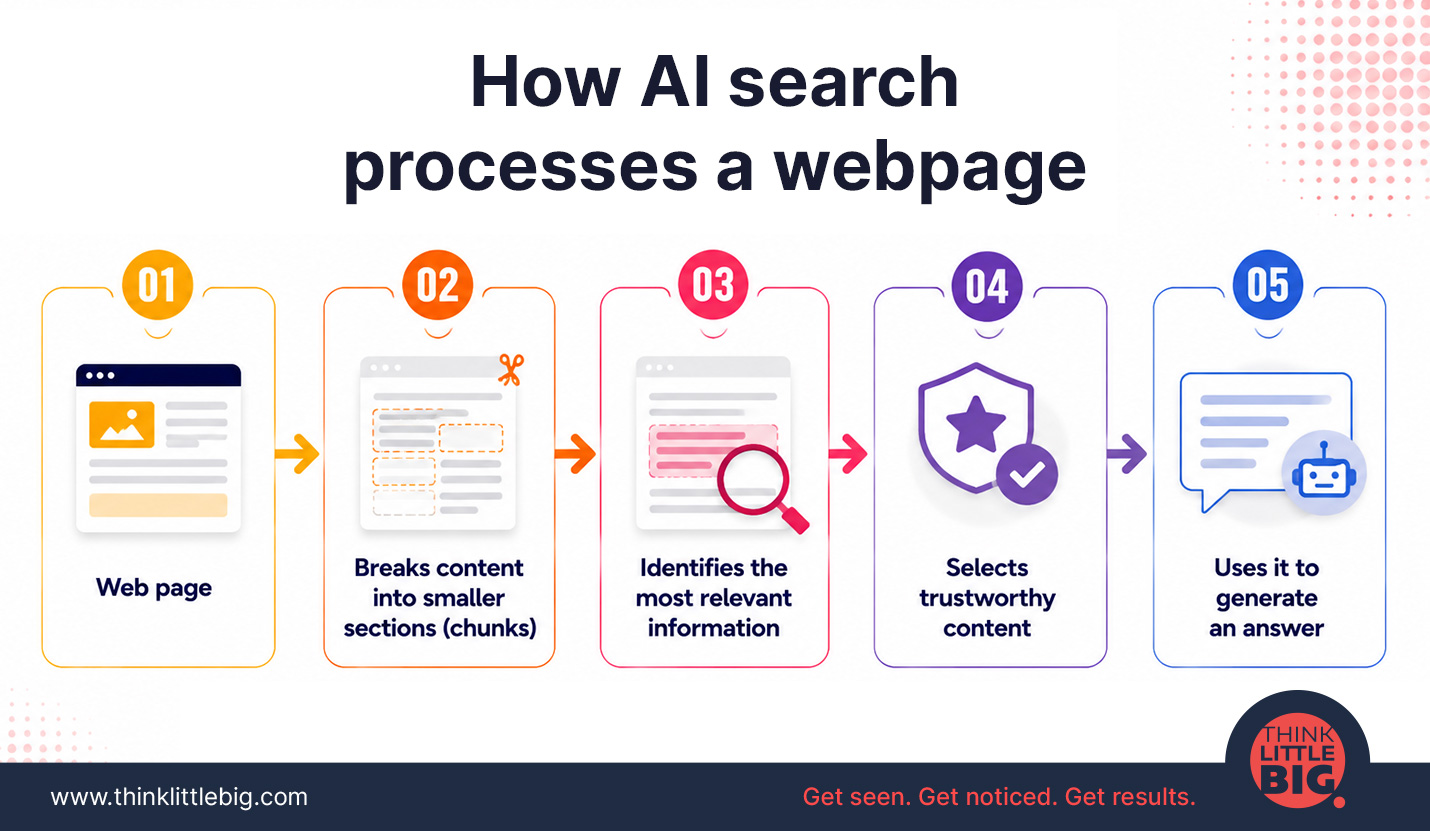
Large language models break a page into smaller segments, work out what each one is actually saying, and build a response from whichever segments fit best. This is often called retrieval augmented generation, or RAG, and it sits behind most AI Overviews and chatbot answers people run into day to day.
The important word there is segment, or “chunk.” These systems don’t read a page from top to bottom the way a person does. They pull out self-contained pieces and judge each one on its own merits.
What this means in practice
- A page organised into clear sections gives a model something usable.
- A long, undifferentiated block of text gives it almost nothing.
- Content should be written so that any single section could be lifted out and still make sense on its own.
The role of E-E-A-T
Google’s E-E-A-T framework, covering experience, expertise, authoritativeness and trustworthiness, was originally written as guidance for human quality raters. It’s turned out to be just as relevant to how AI models judge a source.
Questions AI systems seem to weigh
- Does the content read as though it was written by someone who has actually done the thing being described?
- Is it backed by verifiable data, or does it lean on general claims?
- Does it come from a source with a track record, rather than an anonymous page that could have been produced by anyone?
Which formats AI systems actually cite
The table below sets out the relative citation potential of common content formats.
| Format | AI Citation Potential | Best Use |
| FAQ | Medium | Quick factual answers |
| Comparison page | High | Decision-making searches |
| Guide or how-to | High | Educational queries |
| Table | High | Data, pricing, feature comparisons |
| Original research | Very High | Unique information nobody else has |
| Case study | Very High | Demonstrating real experience |
| Expert commentary alone | Low | Supporting other formats, not standing alone |
The sections below explain the reasoning behind each of these rankings.
FAQs rarely succeed on their own
FAQ sections are a natural starting point, and with good reason. A well written FAQ is already formatted like an answer, a question followed by a direct response, which is close to what an AI system is looking for in the first place.
The catch is that FAQs are often skipped when they address something a model can already work out from its own training data. A generic definition of a marketing funnel, or a textbook explanation of account based marketing, is unlikely to earn a citation, because the model doesn’t need an outside source to answer it.
To improve citation potential:
- Target specific, narrower questions rather than broad industry ones.
- Draw on real figures, timeframes or examples from the organisation’s own work.
- Keep answers concise, two or three sentences before any further expansion.
- Apply FAQ schema markup so the format is easy for machines to identify.
An FAQ section is worth including on nearly every page. It shouldn’t be relied on as a standalone citation strategy though.
Comparison pages attract disproportionate attention
AI tools cite comparison pages considerably more often than standard blog posts.
A query such as “which CRM is better for a mid sized manufacturer,” or a direct comparison prompt like “HubSpot vs Salesforce” or “React vs Vue,” requires weighing several variables at once. A language model can’t reliably produce that kind of judgement from memory alone, since it depends on current, specific, side by side detail. So it looks for a source that has already done that comparison properly.
What tends to separate a strong comparison page from a weak one:
- Genuine trade offs. If every point favours a single option, the AI system has little reason to treat the content as objective.
- Specific figures. Prices, timelines, feature counts and ratings give the model concrete detail to draw on.
- A structured table. Tables are quick to scan and easy to parse for factual detail.
- A decision framework. Content explaining which option suits which situation is more useful than a plain feature list.
Acknowledging where a competitor does something well, or where a recommendation has limits, tends to help rather than hurt. It signals balance, and balance is usually what earns a citation rather than getting quietly passed over.
Stay in the know
Keep on top of how the latest marketing, SEO, branding and design tips can be used to
grow your business – delivered straight to your inbox.


Guides: depth beats breadth
Long form guides still have their place, but the bar has moved. A thin, 500 word “ultimate guide” full of surface level advice doesn’t get much traction anymore. AI systems need enough substance to feel confident treating a page as a source.
The better approach looks closer to a proper pillar piece, something in the range of 1,500 to 2,500 words, covering a topic from several angles.
Habits that help within that structure:
- Answer each section’s core question directly in the first sentence or two, then expand. This is borrowed from journalism’s ‘inverted pyramid’ format, and it gives the model a clean, quotable line right where it expects one.
- Phrase headings as real questions where it makes sense (“How do you measure brand awareness in B2B?” rather than “Measuring brand awareness”).
- Break up dense sections covering a process with numbered steps or bullets.
- Avoid burying the most useful information several paragraphs in.
Written this way, a guide serves two readers at once. A human gets something thorough and well organised. An AI system gets self contained chunks it can lift cleanly, each one already answering a specific question.
Tables leave little room for misreading
Whenever content involves comparing options, pricing, features or structured data, tables consistently get pulled into AI generated answers. Rows and columns don’t leave much space for misinterpretation, which matters when a model is trying to represent data accurately within a summary.
Anything involving numbers, comparisons or specifications will usually outperform in table form compared with the same information written out as prose.
Original research is the format AI trusts most
If one format consistently beats the rest, it’s original research. Surveys, proprietary data, industry benchmarks and first party studies sit at the very top of what AI tools choose to cite, and the reasoning behind that isn’t complicated.
A model can generate a generic explanation of a marketing concept without much difficulty, because that information already exists a thousand times over across the web and is baked into its training data. What it can’t do is invent an organisation’s survey results, client benchmarks or proprietary methodology. That data exists in exactly one place, and if an AI system wants to reference it, it has to point back to the source.
How to get more value from internal data:
- Publish it properly rather than leaving it buried in an internal slide deck, so others can discover, cite, and reference it.
- Give the study a clear, memorable name so it becomes a reference point in its own right.
- Publish the methodology alongside the findings, even briefly, since that builds credibility.
- Update the data regularly, because these systems tend to favour current information over stale figures.
- Present key statistics as standalone, quotable sentences rather than burying them in dense paragraphs.
Original research is probably the strongest lever available for AI visibility, and it’s also the one most organisations invest in least, mostly because it takes real effort to produce. That gap is the opportunity.
Case studies are proof AI can't fabricate
Case studies sit in similar territory to original research. For B2B organisations especially, they’re worth taking seriously. A properly documented case study contains details that don’t exist anywhere else online: the client’s specific challenge, the approach taken, and the measurable result.
Ask an AI assistant how B2B companies improve lead quality through content marketing, and a system assembling that answer benefits considerably from being able to point to a concrete, verifiable example instead of speaking in vague generalities.
What makes a case study citable:
- Lead with the outcome rather than the backstory. State the result early, then explain how it was reached.
- Use real, specific numbers rather than vague phrases like “significant improvement.”
- Name the sector or business type, even where the client itself can’t be named. This helps AI systems match the case study to relevant queries.
- Structure it clearly: challenge, approach, result, so each section stands on its own.
Case studies also tick the “experience” box in E-E-A-T more directly than almost any other format. They’re proof the work has actually been done, not just written about.
Expert commentary is seasoning, not the main course
Expert commentary, opinion pieces and thought leadership all have their place, but it’s worth being honest about what they achieve alone. Pure opinion without data or specific examples tends to get cited far less often than the other formats covered here. AI systems are cautious about presenting subjective viewpoints as factual answers, so standalone commentary often just gets passed over.
Commentary tends to work better when it’s:
- A named expert’s perspective inside a guide or research piece, rather than standing alone.
- Attached to genuine author credentials on every piece of content.
- Attributed to real people within the organisation, name and role included, rather than a faceless corporate voice.
- Used to explain the reasoning behind data already presented, rather than standing in for it.
Commentary brings credibility and personality. On its own though, it rarely gives AI systems the concrete, citable substance they’re looking for.
What AI search tends to skip past
A lot of organisations produce content that’s almost invisible to these systems without realising it.
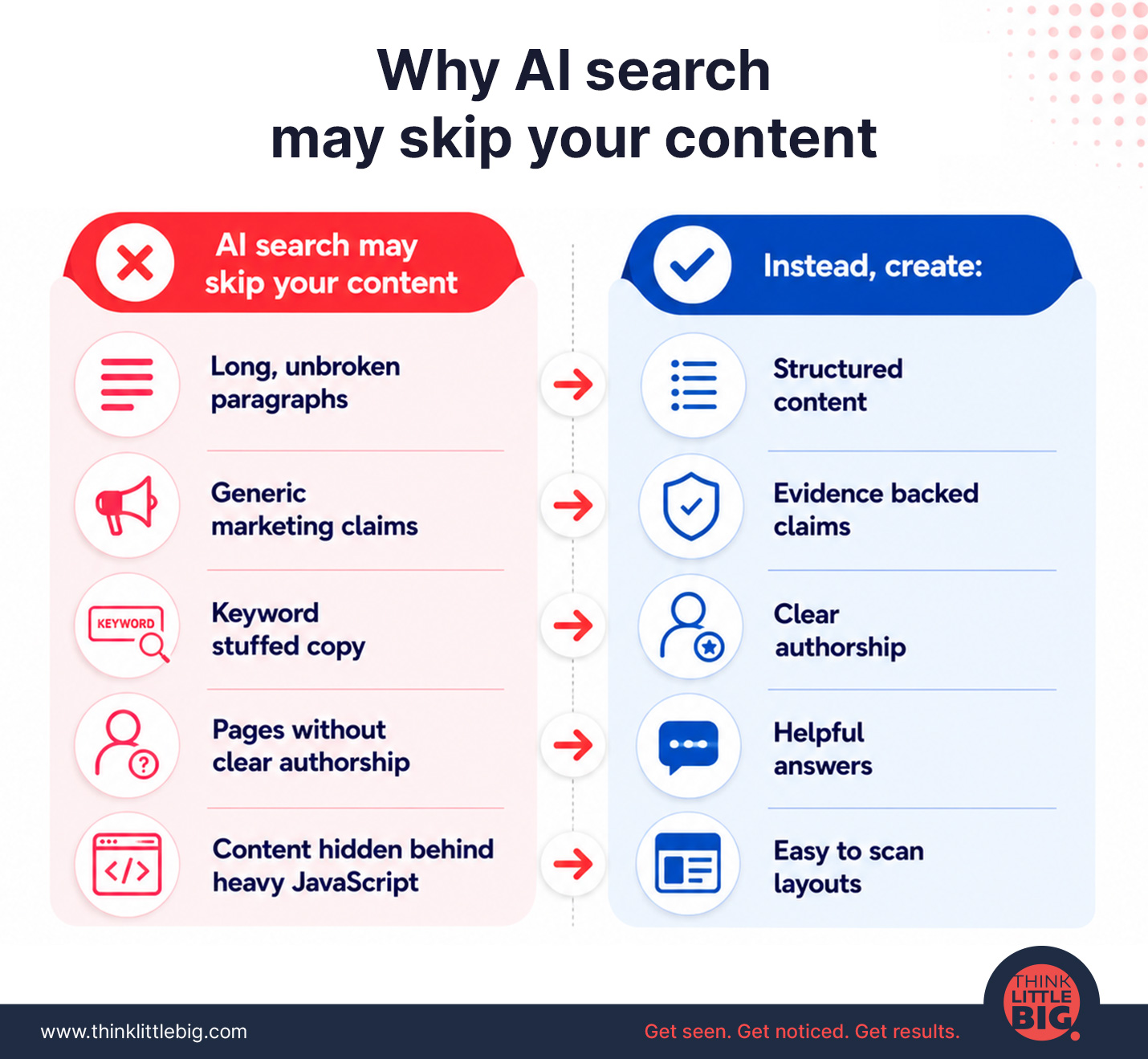
- Long, unbroken paragraphs are hard to chunk cleanly, so models tend to skip past them in favour of better structured competitors.
- Vague statements like “we deliver exceptional results” give an AI system nothing concrete to cite.
- Content buried behind heavy JavaScript causes problems too, since crawlers can struggle with pages that rely entirely on client side rendering.
- Keyword stuffed copy left over from an older SEO playbook reads as dated rather than genuinely useful.
- Pages with no clear authorship or credentials tend to fare worse, since trustworthiness carries real weight in how these systems judge a source.
Bringing it all together
None of these formats do much on their own, and that’s really the point. Organisations seeing the best results in AI search aren’t fixated on one format. They’re building a mix of FAQs for quick, specific questions, comparison pages for decision making queries, guides for depth, tables for unambiguous data, research and case studies for proof, and expert commentary tying it all together with a credible, human voice.
The habits that carry most of the weight
- Answer the question in the first couple of sentences of every section before expanding.
- Use question style headings for H2s and H3s.
- Break dense information into lists and tables rather than paragraphs whenever the content covers steps or comparisons.
- Back up claims with real numbers or specific examples instead of vague statements.
- Attribute content to named people with real expertise.
- Keep pages current rather than letting them go stale.
AI search doesn’t reward the longest content or the most keywords anymore. It rewards content that’s easy to understand, backed by evidence, and structured so each section can stand on its own. Organisations that adapt to this will become the sources’ AI quotes. The ones that don’t will end up left out of the answer.
Want help getting there?
Auditing every page yourself takes time, and it’s easy to miss where the real gaps are. If you’d like a second pair of eyes on your content, or help building a format mix that’s genuinely built to earn citations, get in touch with TLBM. We’ll walk through what’s working, what isn’t, and where the quickest wins are sitting.