If you’ve been staring at your analytics dashboard wondering where all your traffic has gone, you’re not imagining things. Marketers everywhere are watching organic sessions slide even when their rankings look perfectly healthy.
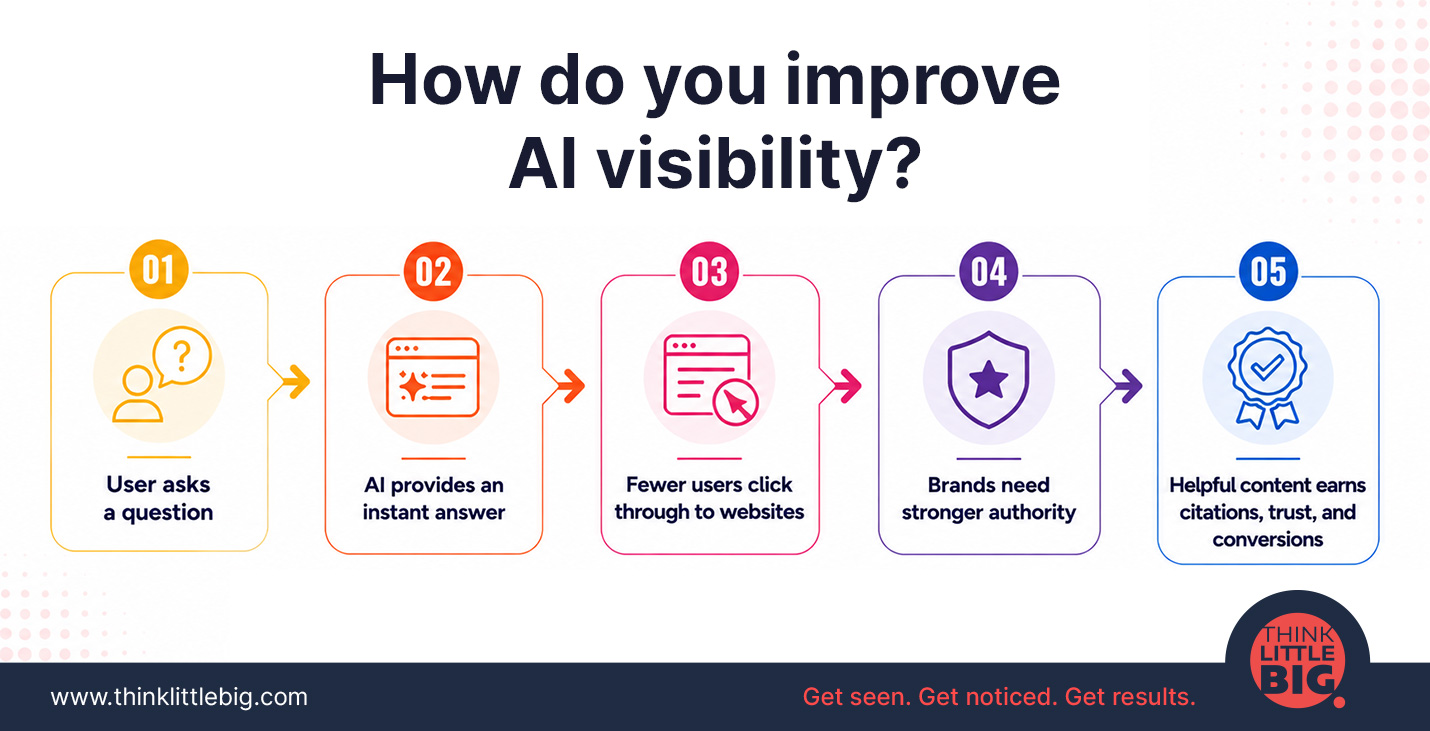
The culprit isn’t a Google penalty. It’s AI Overviews, AI Mode, ChatGPT, Perplexity and Copilot answering questions directly on the page or in a chat window, often without sending anyone to your site. Zero-click searches are becoming increasingly common as users now get the answers they need without visiting a website.
This isn’t a temporary blip. It’s a structural shift, and it means “rank higher, get more clicks” no longer tells the full story.
So the real question isn’t just how to get your traffic back. It’s whether you’re still measuring the right thing. Let’s work through what’s happening, how to adapt your KPIs, how to measure brand visibility, and how to build content that earns its keep either way.
Why your traffic is falling even though you're still ranking
It helps to understand the mechanics before you start changing your strategy. There are two separate forces at play here, and they often get lumped together as if they’re the same thing.
Zero click search isn't new, but it's accelerating
Zero click results have existed since Google introduced featured snippets and knowledge panels years ago. What’s changed is the scale.
AI Overviews now trigger on a huge proportion of informational queries.
When they do, users are far less likely to click through to any website at all. Some analyses suggest that click through rates to traditional organic results fall by more than half when an AI Overview is present on the page.
AI chat platforms are pulling queries away from search entirely
It’s not just Google either. A growing number of people are skipping search engines altogether and asking ChatGPT, Perplexity or Gemini directly.
These tools read your content, synthesise an answer, and present it to the user. Often, they don’t mention where the information came from unless they specifically choose to cite you.
The impact isn't even across content types
Here’s the bit that often gets missed. Informational content is hit hardest. Think “what is” and “how to” articles, the kind that make up so many company blogs. This is exactly the type of content AI tools summarise well.
Transactional and navigational searches are far less affected. If someone wants to actually buy something or reach a specific page, an AI answer can’t complete that task for them.
E-commerce queries have seen comparatively modest AI Overview coverage for this reason. Product searches still require people to view images, compare prices, read reviews and complete a purchase somewhere.
So if your blog traffic has fallen sharply but your product page conversions look steady, that’s not a coincidence. It’s the expected pattern given how these systems work.
Why chasing the old traffic numbers is a losing game
Here’s the honest truth. If your KPIs are still built entirely around sessions, pageviews and organic click volume, you’re measuring a channel that’s shrinking through no fault of your own.
You could produce genuinely excellent content, rank in position one, and still see fewer visitors than you did two years ago. That doesn’t mean your content strategy has failed. It means the yardstick has changed.
Trying to claw back the exact traffic numbers you had a couple of years ago, using the exact same tactics, is a losing game. You need a new scorecard, not just harder effort against the old one.
Adapting your KPIs for the AI search era
This is where most teams need to make their biggest mental shift. Traffic alone was always a proxy metric anyway. It stood in for the things that actually matter: awareness, trust, leads and revenue.
It’s time to bring those real outcomes closer to the surface, rather than relying on session counts to tell the whole story.
Move beyond sessions as your headline metric
Rather than treating total organic sessions as your north star, consider tracking a blend of metrics instead:
- Assisted conversions and multi touch attribution: Someone might read an AI summary of your content, never click through, then later search your brand name directly and convert. That journey deserves credit somewhere in your reporting.
- Branded search volume: If more people search your company or product name over time, that’s a strong signal your visibility efforts are working, even without a direct referral.
- Conversion rate and lead quality from the traffic you do get: Several studies have found visitors who click through after reading an AI summary are more qualified. They’ve already filtered out the casual browsers before arriving.
- Citation frequency in AI answers: How often does your brand, your data or your content get referenced inside AI Overviews, ChatGPT responses or Perplexity results? Being cited without a click still builds trust and recall.
Set expectations by content type
Not every page should be judged the same way.
A pricing page or product comparison page should still be judged largely on clicks and conversions. Those queries retain more commercial intent, so the old rules still mostly apply.
A “what is” style blog post is a different story. It’s increasingly a citation and authority play rather than a traffic play. If you keep judging that post purely on sessions, you’ll wrongly conclude it’s failing, when it might be doing exactly its new job well.
Report on trends, not single month snapshots
Zero click growth has been gradual but persistent for years now. A single dip in monthly traffic might reflect seasonality or a Google update rather than AI displacement specifically.
Look at rolling quarterly trends instead. Pair this with impressions data in Search Console to get a fuller picture.
If impressions are holding steady but clicks are falling, that’s the classic signature of zero click behaviour. It points to something different than a straightforward ranking problem.
Build a simple reporting framework your team can actually use
Numbers only help if people act on them. Try building a short monthly scorecard that covers:
- Organic sessions and impressions, tracked together rather than in isolation
- Branded search volume trend
- Citation appearances for your top priority topics
- Conversion rate by content type
- Assisted conversions from informational content
This keeps the conversation focused on outcomes rather than a single, shrinking number.
How to actually measure brand visibility
Brand visibility used to be a soft, slightly fuzzy concept. It sat somewhere between PR and marketing, hard to pin down with numbers.
In the AI search era, it’s becoming one of the most concrete, trackable assets a business has. Here’s how to get a proper handle on it.
Track your presence inside AI Overviews and chat answers
Run a regular audit of the queries that matter most to your business. Check whether your brand, your data or your content is being cited.
Several SEO platforms now show which of your keywords trigger AI Overviews, and whether you’re the cited source. You can also do this manually by searching your priority terms across Google, ChatGPT and Perplexity, and simply noting whether you appear.
Monitor branded search growth
An increase in people searching your company name, product names or founder names is a clear signal. It usually means your visibility work outside the click is paying off.
Google Trends and Search Console’s branded query data are both useful starting points for this kind of tracking.
Watch referral traffic from AI platforms specifically
Set up a custom channel grouping in your analytics tool. Capture referrals from sources like chatgpt.com, perplexity.ai and other AI search tools separately from your usual organic bucket.
This traffic is still small for most sites. But it’s growing quickly, and early data suggests it converts well, because these visitors arrive already informed and interested in what you offer.
Track share of voice, not just share of clicks
If you operate in a competitive niche, consider tracking how often you’re mentioned versus your competitors across AI answers for your core topics.
Being the brand an AI model reaches for has real commercial value, even when it doesn’t send a click. Businesses cited inside AI Overviews have been shown to earn noticeably more organic and paid clicks than uncited competitors on the same queries. That citation acts as a trust signal for the searcher.
Don't ignore the qualitative signals
Sales and customer service teams often hear things before your dashboards catch up.
If prospects start saying “I saw you mentioned when I asked ChatGPT about this,” that’s valuable evidence. Make sure that feedback actually reaches your marketing team, rather than staying buried in a sales call note somewhere.
Consider a lightweight visibility audit each quarter
You don’t need expensive tools to get started here. A simple spreadsheet works fine.
- List your top 20 to 30 priority queries
- Check each one across Google, an AI Overview if present, ChatGPT and Perplexity
- Note whether you appear, and where
- Track this over time to spot trends
This gives you a rough but genuinely useful visibility baseline within a day or two.
Stay in the know
Keep on top of how the latest marketing, SEO, branding and design tips can be used to
grow your business – delivered straight to your inbox.


Creating content that works for both AI and traditional search
The good news is that the fundamentals of good content haven’t disappeared.
If anything, they matter more now. AI systems are choosy about what they cite, and they tend to favour sources that demonstrate real experience, expertise, authority and trust.
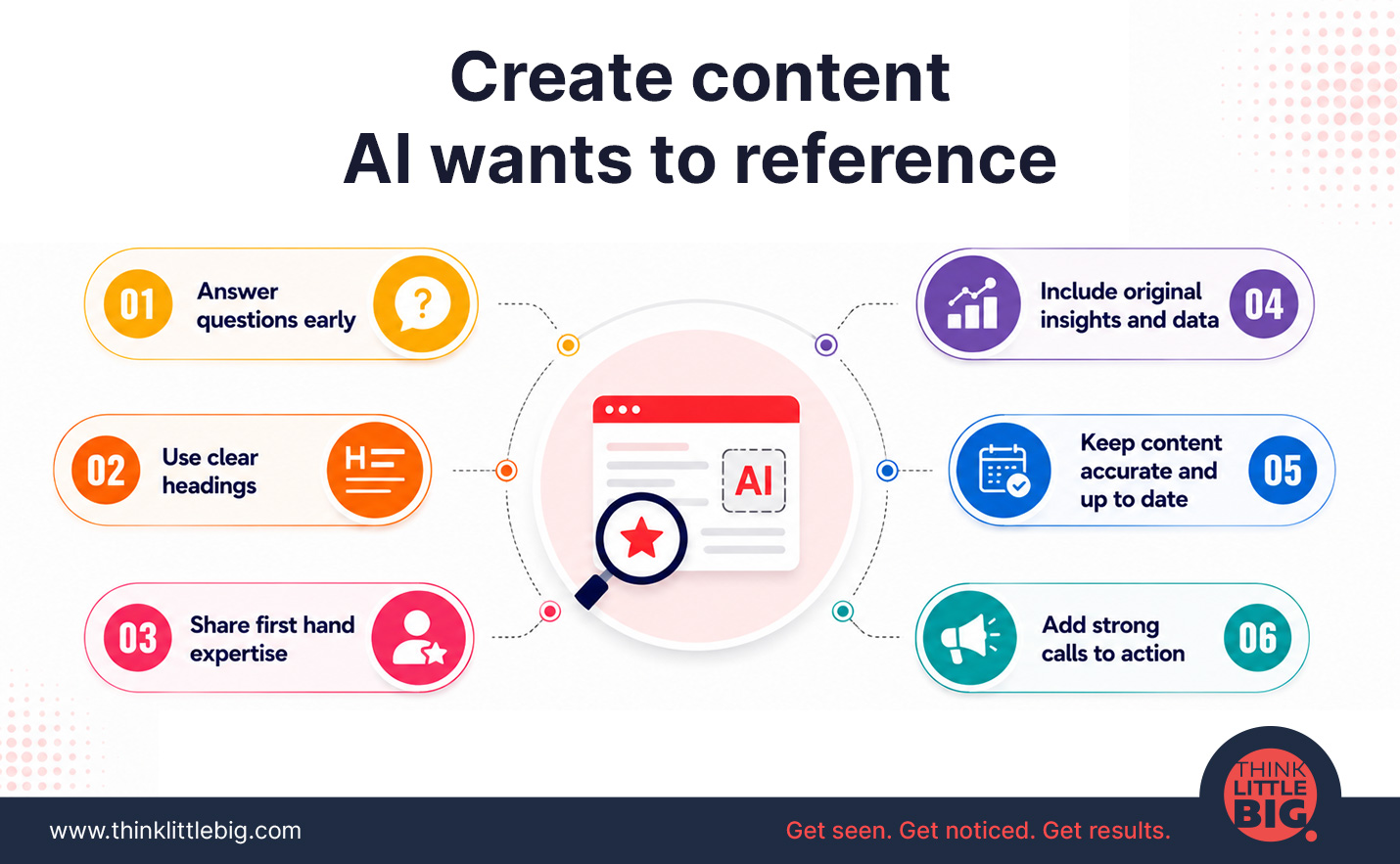
Answer the question clearly and early
AI summarisation tools favour content that states its answer plainly near the top, then backs it up with detail underneath.
Bury your key point under three paragraphs of preamble and you make it harder for both readers and AI systems to extract your answer. Say what you mean, then explain it properly.
Show your working, and show real expertise
Generic, rehashed advice is easy for an AI model to summarise from a dozen competing sources. That means there’s no strong reason to cite you specifically over anyone else.
Original data, case studies, first hand experience and clearly credentialed authorship give AI systems a reason to point at you rather than paraphrase you into obscurity. This is also exactly what Google’s own quality guidance rewards, since it favours content demonstrating genuine experience rather than surface level summaries.
Structure content for extraction
Use clear headings, well labelled lists, defined terms and, where relevant, structured data markup.
This doesn’t just help traditional SEO crawlers. It also helps AI systems parse and lift specific facts accurately, which increases your odds of being cited correctly rather than misquoted or skipped entirely.
A few practical habits worth adopting:
- Put the direct answer in the first sentence or two of a section
- Use descriptive subheadings rather than clever or vague ones
- Break complex processes into numbered steps
- Keep sentences reasonably short and specific
Keep information current and factually tight
AI systems increasingly weigh freshness and factual consistency when choosing what to surface.
Outdated statistics or vague claims without sourcing make your content less trustworthy, both to human readers and to AI crawlers scanning for reliable sources. Regularly updating key pages, correcting inaccuracies quickly and citing your own sources properly all help here.
Write for the whole funnel, not just the top
Informational content is where AI absorbs the most clicks. So it makes sense to lean more heavily into content that still requires a visit to be useful.
Consider investing more in:
- Interactive tools and calculators
- Personalised product recommendations
- Detailed product or service comparisons
- Pricing pages with real specifics
- Community discussions and forums
- Gated resources like templates or worksheets
Your top of funnel blog content still matters for authority and citations. But your conversion focused content probably deserves a bigger share of your creative energy than it did a couple of years ago.
Build content that supports internal linking and lead capture
Even when a blog post itself isn’t the final destination for many readers anymore, it can still do useful work.
It can link clearly to your transactional pages. It can capture newsletter sign ups. It can feed your sales pipeline through well placed calls to action.
Think of informational content less as a standalone traffic driver now. Think of it more as a supporting layer that builds trust and funnels people toward the pages that actually convert.
A quick checklist to get started this month
If all of this feels like a lot to take in, here’s a practical starting point.
- Audit your top 20 queries across Google, AI Overviews and ChatGPT to see where you currently stand
- Add branded search volume and citation tracking to your monthly reporting
- Reclassify your content by intent, and set different success metrics for each type
- Update your three or four most important informational pages with clearer structure and fresher data
- Add or strengthen calls to action within your blog content, linking through to conversion pages
- Set up a separate channel grouping in analytics for AI platform referrals
None of this needs to happen overnight. Small, steady changes compound over a few months.
Bringing it all together
A drop in website traffic driven by AI search isn’t a sign that your content strategy has failed. It’s a sign that the entire measurement framework built around search traffic needs an update.
The businesses that come out ahead won’t be the ones panicking over falling session counts. They’ll be the ones broadening their KPIs to include citations, branded search and conversion quality. They’ll be actively measuring their visibility inside AI answers, rather than guessing at it. And they’ll keep creating content genuinely useful enough to earn a citation, a click or a return visit.
Search isn’t going away, and neither is the value of good content. What’s changing is where and how that value gets captured.
Adjust what you measure. Keep building content that demonstrates real expertise. Do both consistently, and you’ll find there’s still plenty of opportunity in a search landscape that looks very different from the one you got used to.
Need help making sense of your own numbers?
Every website’s situation looks a little different, and working out which of these changes matter most for your business can take some digging.
If you’d like a second pair of eyes on your traffic trends, your visibility across AI search or your current content strategy, we’re happy to help. Get in touch with our team today and we’ll walk you through what we’re seeing and where the real opportunities lie for you.