Something changed quietly. The way buyers research services and suppliers looks quite different today than it did two or three years ago, and most businesses haven’t caught up.
ChatGPT, Perplexity, Google Search’s AI Overviews and Microsoft Copilot; a growing number of buyers use these before they ever land on a company website. Sometimes before they’ve properly defined what they’re looking for. The research phase that used to happen on page one of Google is increasingly happening inside a conversation with an AI tool.
Google’s AI Overviews now appear for a significant proportion of searches, particularly informational queries, and continue to expand as Google rolls out the feature. Several industry studies suggest AI Overviews can reduce click-through rates to traditional organic listings, particularly for informational searches.
Increasing numbers of buyers now use AI tools such as ChatGPT, Perplexity and Google’s AI features alongside traditional search when researching products and services. This represents a shift in behaviour that most businesses haven’t adjusted to.
The gap shows up slowly. Leads become a little harder to come by. Organic traffic dips in ways that feel explainable by other things. Then one day the trend line is obvious, and the competitors who adapted earlier are somewhere in the distance.
Why the advice out there is all over the place
If you’ve spent any time researching this, you’ve probably noticed that nobody seems to agree on what to actually do. Agencies are selling AI search packages. Tool vendors are pushing conflicting recommendations. LinkedIn is full of people declaring everything has changed and you need to act immediately.
Google’s own documentation says something calmer. You don’t need llms.txt files. You don’t need to break your content into chunks for AI systems. You don’t need to rewrite your whole site. Their view is that good SEO was always good SEO, and the fundamentals matter more now because AI systems are far harder to fool than traditional crawlers ever were.
AI systems evaluate content differently from traditional search engines. Rather than relying heavily on keyword matching, they’re designed to identify information that best answers the user’s question. It notices when a page talks around a question without answering it. It notices when content exists to rank rather than to inform. The businesses winning in AI search right now aren’t the ones who found a new loophole. They’re the ones who built something genuinely worth citing.
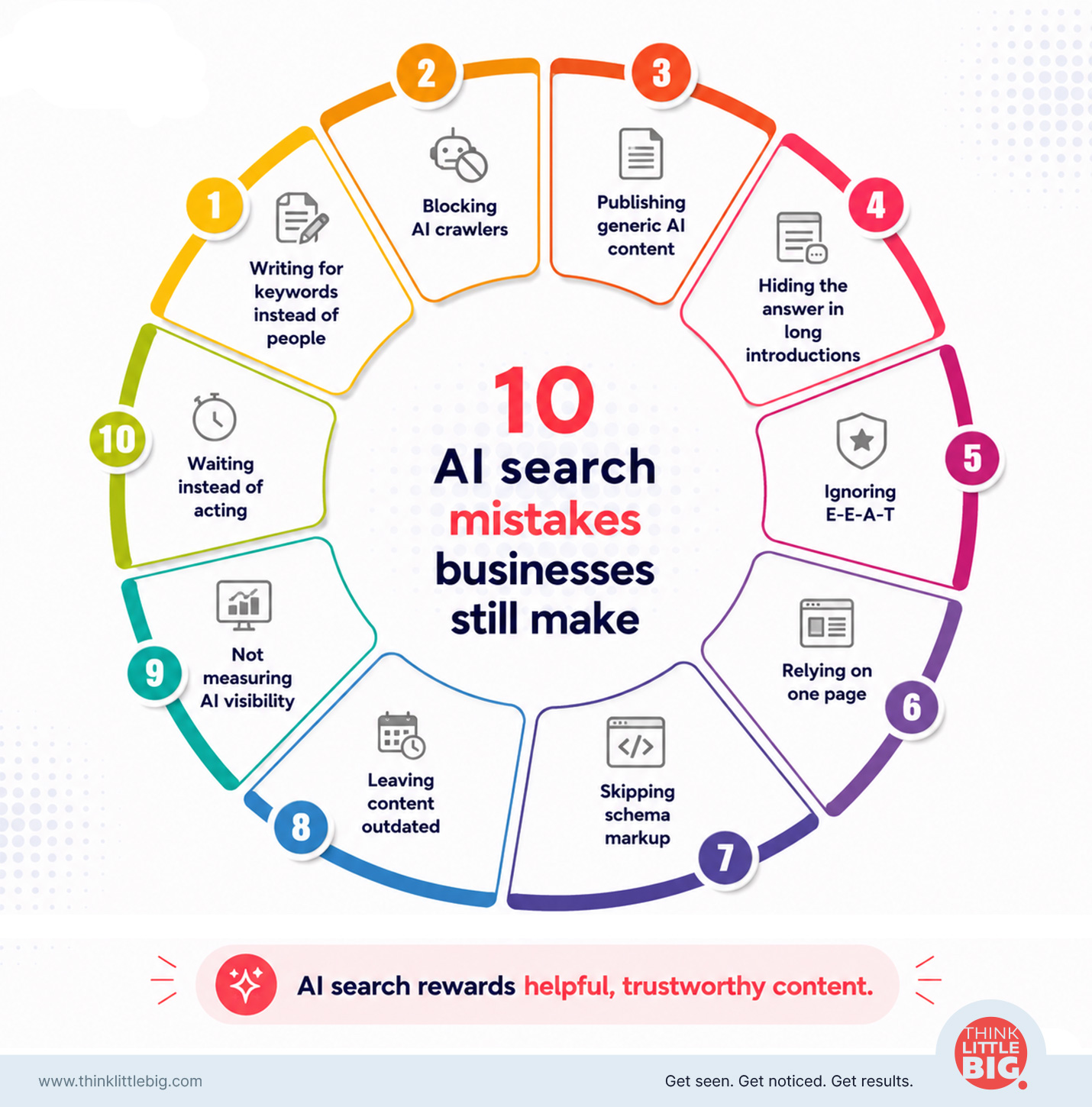
The mistakes we see most often
1. Assuming the old approach is still good enough
For years, SEO rewarded a particular kind of content production. Keyword targets, structural signals, internal linking, volume. Pages were built to rank, and ranking was the goal. Whether those pages actually helped anyone was somewhat secondary.
AI search has different priorities. It’s trying to match content to what someone genuinely wanted to know, not just what they typed. A page optimised for “B2B content marketing agency London” can tick every technical box and still be completely useless to a buyer who wants to understand what working with an agency actually involves, what it costs, and what results are realistic.
AI systems notice that gap. A page that addresses real questions from real buyers, directly and honestly, with enough specificity to be useful, performs better in AI search than a page designed primarily to satisfy a crawler.
Businesses that haven’t updated their content strategy since 2022 are competing with a playbook that no longer fits. Some of those tactics have become actively counterproductive, producing pages that AI systems recognise as thin and pass over entirely. Writing for crawlers was always a compromise. Now it’s a liability.
2. Blocking the crawlers you need
Many websites use Cloudflare or similar services, and the default settings may be blocking AI crawlers you actually want to allow. If nobody on your team reviewed those settings when that change rolled out, there’s a reasonable chance your site has been invisible to major AI crawlers for some time.
The same issue appears in robots.txt files. Rules added years ago to stop scrapers can also block GPTBot, ClaudeBot, PerplexityBot, and Google-Extended. Nobody added those rules with that intention, but the effect is the same.
Check yourdomain.com/robots.txt. Look at your Cloudflare dashboard. Review whether important pages carry noindex tags that shouldn’t be there. Make sure content that matters isn’t buried behind a login or loaded entirely through JavaScript, as both make pages effectively invisible to crawlers.
This is the most mechanical item on the list and worth doing first. There’s no point refining content that AI systems can’t read.
3. Publishing AI writing without adding anything to it
Many businesses started producing more content by leaning heavily on AI writing tools, and a lot of that content is thin. It covers topics without really saying anything. It sounds plausible but offers nothing that could only have come from a business with actual experience in its field.
Google’s Quality Rater Guidelines place greater emphasis on identifying low-quality, mass-produced content that lacks originality or value to users.
Mass-produced pages with no original thinking get the lowest quality rating human reviewers can give, regardless of how they were produced. The same qualities that receive low ratings under Google’s Quality Rater Guidelines are also less likely to be useful to AI search systems, which tend to favour authoritative, trustworthy and well-cited sources.
The algorithm issue is almost secondary. Generic content doesn’t build trust. It doesn’t make someone feel confident about getting in touch. It creates a sense that the business behind the website doesn’t have much to say for itself.
Using AI tools to help draft or structure content isn’t the problem. Publishing content with no genuine thinking, no specific examples, and nothing that reflects actual experience in the field is. That distinction matters, and both readers and AI systems are increasingly good at making it.
Stay in the know
Keep on top of how the latest marketing, SEO, branding and design tips can be used to
grow your business – delivered straight to your inbox.


4. Taking too long to get to the point
AI systems often extract concise passages that directly answer a user’s question, so getting to the point early can improve the likelihood of your content being surfaced. Long introductions that delay answering the user’s question can reduce the chances of your content being selected.
The same logic applies within a piece. Lead with the answer, then support it. Subheadings should reflect real questions, not vague topic areas. Paragraphs should be short enough that the key information isn’t hidden three sentences in.
Many businesses inherited a content style built around long introductions and gradual build-up. AI systems are designed to identify the passages that most directly answer a user’s question. They scan for the most relevant passage and pull from it. If your most useful content is buried in a long preamble, it may never get cited regardless of how good it is.
5. Underinvesting in signals that build trust
E-E-A-T, Experience, Expertise, Authoritativeness, Trustworthiness, is Google’s framework for assessing content quality. AI platforms use the same logic when deciding which sources to cite.
Early studies suggest AI systems frequently reference established publishers, respected industry websites and other trusted third-party sources. Features in trade publications, mentions from recognised names in your sector, reviews and case studies that demonstrate real outcomes all contribute to stronger online authority and can improve your visibility in AI search. They’re more than just brand-building activities. They can strengthen your online authority and improve the likelihood of your business being cited by AI search tools.
Strengthen author bios so the people behind your content are clearly identified. Include data and examples that only your business could have produced. Pursue coverage from sources that AI systems already trust. A well-placed feature in a credible publication keeps generating authority signals long after it was published. That’s worth factoring into where you spend your time.
6. Relying on one page to do everything
When someone asks an AI tool a complex question, the system breaks it apart and searches for components separately. This is called query fan-out, and it has a direct effect on what content strategy pays off.
Take a question like “what email marketing platform works best for a small ecommerce store?” That might generate four separate searches covering pricing, integrations, deliverability, and ease of use. The AI synthesises answers from several sources and presents something coherent. A competitor with several well-targeted pieces covering those sub-topics may have more opportunities to appear in AI-generated answers than a business relying on a single comprehensive guide.
This doesn’t mean abandoning depth. It means pairing depth with coverage across the full range of questions your buyers are asking. A content strategy mapped to component questions, not just top-level topics, will consistently outperform one that isn’t.
7. Leaving schema markup off the to-do list
Schema markup tells search engines and AI systems what kind of content they’re looking at. Without it, they infer. Without structured data, search engines and AI systems have to infer more about your content, which can make it harder for them to understand and classify your pages accurately.
FAQ schema helps for question-and-answer content. Article schema adds value to editorial pieces, particularly when author information is included. Organisation schema establishes business identity. Local Business schema matters for location-specific services. Product and Review schema are important for ecommerce. A developer can implement most of this in a few hours. The work is unglamorous and the payoff is real.
8. Not keeping content current
For topics where information changes regularly, AI search systems favour recent content, particularly on topics where things change. A 2023 guide left untouched will lose ground to a well-maintained 2026 equivalent, even if the older piece was originally better. Keep your important pages updated.
The fix doesn’t require rewriting from scratch. Updating statistics, adding recent examples, revisiting conclusions, expanding sections that have become thin — these all send the right signal. They communicate that this is a current resource rather than something published and forgotten.
A quarterly review of your most important pages is a manageable starting point. The pages that drive enquiries, explain your core offering, and address the questions buyers ask most often are worth maintaining actively.
9. Not measuring any of this
Many organisations are still developing ways to measure their visibility in AI search, making it difficult to understand what’s working. They’re making content decisions without any feedback on whether those decisions are working.
Start by running your core queries through ChatGPT, Perplexity, and Google’s AI Overviews. Note where your business appears and where it doesn’t. Track citation frequency over time. Compare your visibility against competitors on the topics that matter commercially. Track AI-attributed traffic in Google Analytics 4.
Without measurement, you can’t tell what’s working and where to focus next. Businesses that build even a basic feedback loop around AI search visibility will make better decisions faster than those operating without one.
10. Watching instead of acting
The most common position we encounter: the business leader knows AI search is changing things, is keeping an eye on it, and will do something once the picture is clearer.
Authority compounds. The businesses earning credible mentions, producing content that actually helps people, and getting their technical foundations right are building a lead now. Most small and mid-sized businesses haven’t started. That’s an opportunity, but it won’t stay the same size indefinitely.
The picture isn’t going to get clearer in a way that makes the decision easier. More buyers are incorporating AI tools into their research process before making purchasing decisions. The question isn’t whether it’s happening. It’s whether your business is visible when it does.
Every quarter spent watching is a quarter of compounding that goes to someone else.
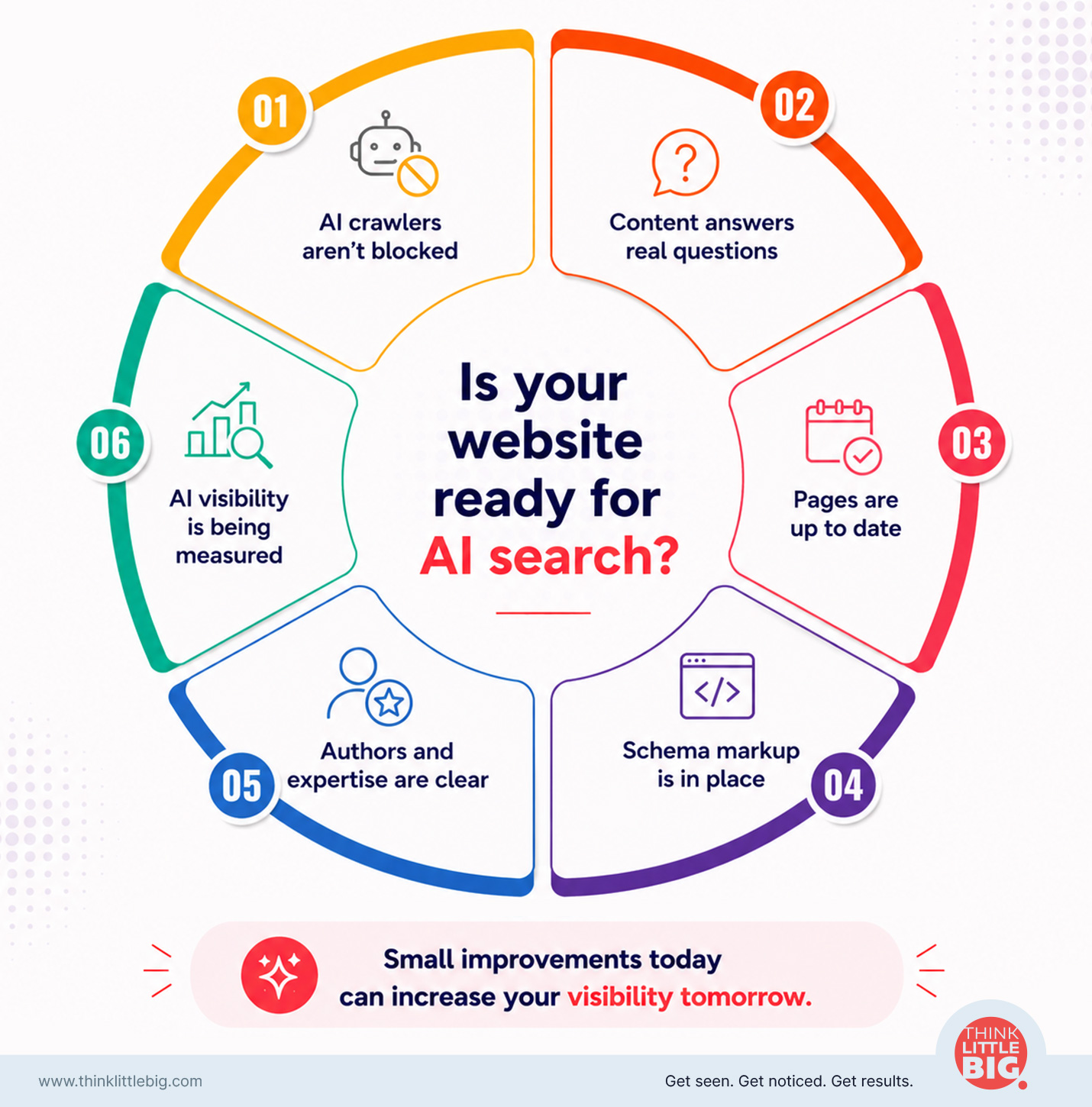
Where to begin
For most businesses, the right first move is an honest audit. What are you publishing? How is it structured? Is it attributed to real people with real credentials? Can AI systems actually access it? Are you appearing when buyers ask the questions that matter to your business?
Most of what needs fixing doesn’t require starting over. It requires someone deciding this is worth taking seriously now rather than later.
At Think Little Big, we help businesses improve their visibility across search, AI discovery and digital channels through content marketing, SEO, graphic design, and website development. If you’d like to discuss your AI search strategy, contact us today and we’d be happy to help.