There’s a question coming up constantly in marketing conversations: how do we rank number one in AI search?
AI tools have changed how people research, compare options, and make purchasing decisions. If your potential customers are asking ChatGPT or Google’s AI Overviews for recommendations, you want to be the brand that comes up. That instinct makes sense. The goal sitting behind it doesn’t.
There is no position #1 in AI search
When Google dominated search, ranking first genuinely mattered. The first result captured far more clicks than the second. That trained an entire generation of marketers to think about visibility as a positional game.
AI tools don’t work that way. Many AI search systems don’t simply rely on what they learned during training. They retrieve fresh information from the web before generating an answer. That means the content available online today still plays a major role in whether your brand is mentioned.
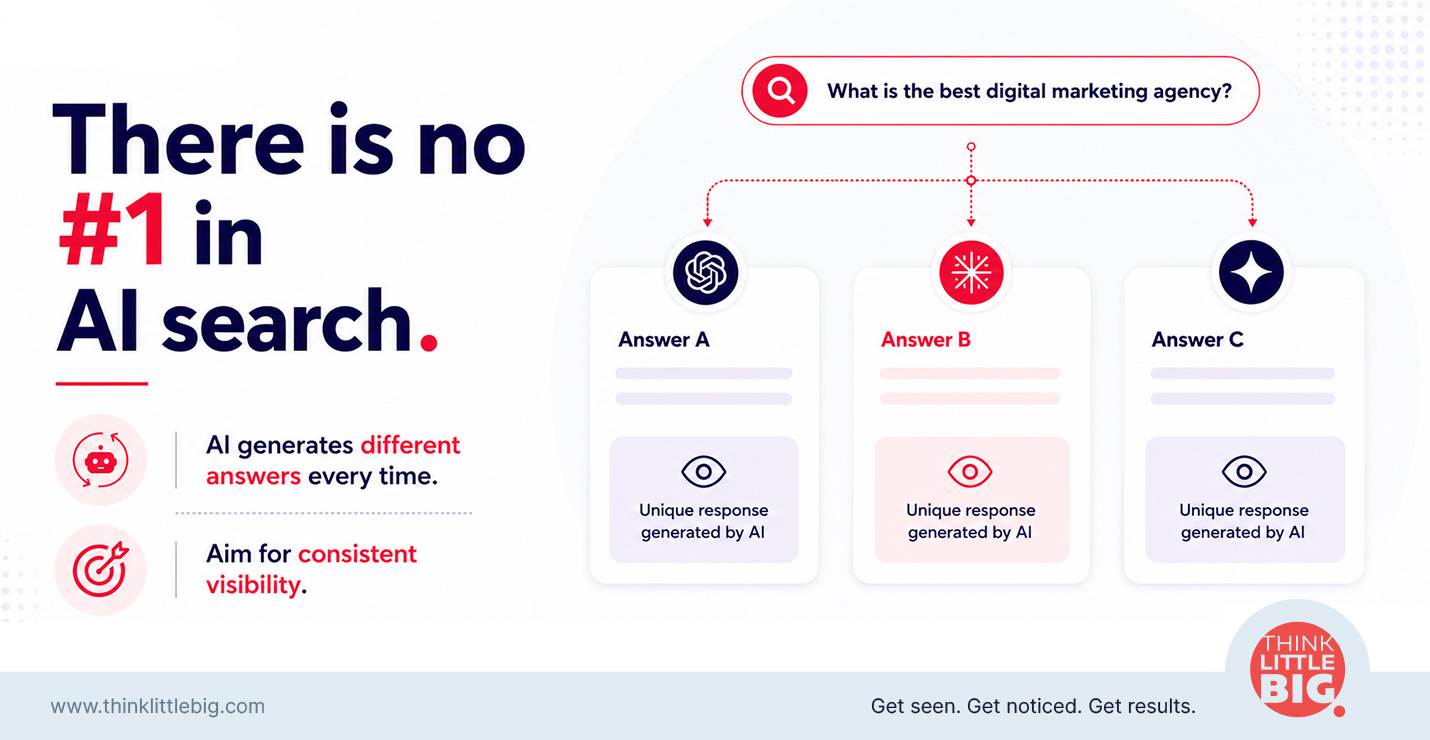
Ask ChatGPT the same question repeatedly and you’re likely to see different brands, different ordering and different levels of detail.
Rand Fishkin and Patrick O’Donnell tested this through research published at SparkToro, using data from Gumshoe.ai. Six hundred volunteers ran 12 identical prompts through ChatGPT, Claude, and Google’s AI Overviews, 2,961 times in total. The result: less than a 1 in 100 chance of getting the same list of brands in any two separate responses to the same prompt. For identical ordering, the odds were roughly 1 in 1,000.
There is no number one spot to hold. Chasing it is like trying to win the same lottery twice with the same ticket.
Why AI responses are different every time
This isn’t a bug. It’s how these systems are built.
AI tools generate responses based on statistical patterns in training data. Each generation introduces variation. The same question doesn’t produce the same answer because the model is working through probability, not pulling from a fixed list.
Every response varies across three things:
- Which brands get included at all: Inclusion isn’t guaranteed, even for well-known names in a category.
- The order they appear in: Position shifts between runs, often significantly.
- How many brands are listed: Sometimes three, sometimes more than ten, with no consistent pattern.
Claude tends to hedge more. ChatGPT tends toward confident, definitive lists. Google’s AI Overviews draw heavily from live web content. The surface behaviour differs. The underlying variability doesn’t.
The right question isn’t “how do we rank first.” It’s “how do we show up consistently.”
Not every AI search tool works exactly the same
ChatGPT, Google’s AI Overviews, Gemini, Claude and Perplexity all generate answers differently. Some rely more heavily on live web retrieval, while others lean more on their underlying language models depending on the query. The exact weighting varies, but the principle is consistent: they favour information that appears credible, well-supported and widely recognised across multiple trusted sources.
People ask AI questions differently than they search Google
On Google, someone types “best B2B content marketing agency.” On ChatGPT, that same person could write three sentences explaining their business, goals, budget and challenges. The intent is the same, but the wording and context are completely different.
The SparkToro analysed 142 prompts from people all looking for the same thing: a recommendation for headphones for a travelling family member. Although the underlying intent was consistent, the prompts were phrased so differently that the average similarity score was just 0.081 out of 1. AI recognised the shared intent, but because each prompt included different wording and context, it didn’t treat them as identical searches and the responses varied.
With traditional SEO, you could target a defined list of high volume keywords. AI search doesn’t work that way. The range of possible prompts is far broader, which means visibility depends less on matching specific phrases and more on building strong associations between your brand, your expertise and the topics you want to be known for.
AI often breaks one question into many searches
There’s another important difference. Modern AI search systems don’t always look up a single query. Many break a prompt into several related searches before generating a response, a process sometimes referred to as query fan-out. For example, a question like “What’s the best B2B marketing agency for a SaaS company?” might trigger separate searches around content marketing expertise, SEO capabilities, client reviews, pricing, industry experience and case studies before the AI combines everything into a single answer.
That means optimising for one keyword isn’t enough. Your brand needs to demonstrate expertise across the wider topic if you want to appear consistently in AI-generated recommendations.
What actually works
Despite the wide variation in how people phrase their questions, some brands appear consistently across hundreds of different prompts.
When Google’s AI was repeatedly asked to recommend digital marketing consultants with e-commerce expertise, one agency appeared in 85 out of 95 responses, according to SparkToro and Gumshoe.ai. When ChatGPT was asked about cancer care hospitals on the West Coast, one hospital appeared in 69 out of 71 responses. That’s because the AI had built a strong association between those brands and the topics users were asking about.
The wording of the prompts changed, but the underlying intent remained similar. Brands with strong topical authority and clear signals of expertise were recommended again and again, regardless of how the question was asked. That’s why succeeding in AI search is less about targeting individual keywords and more about becoming a recognised authority within your area of expertise.
The metric worth tracking
Stop asking where you rank. Start asking how often you appear when someone asks about your category.
If your brand shows up in 80 out of 100 runs of a relevant prompt, that’s 80% visibility for that query type. That number reflects something real. It shifts when you do real work. A ranking position tells you almost nothing because it’s different in every single run.
Those 142 differently phrased headphone prompts returned the same handful of brands consistently, regardless of how the question was asked. The AI understood the underlying intent and returned the brands it associated most strongly with that topic. That association is built over time, across many sources. You can’t shortcut it.
Run ten to fifteen relevant prompts each month across ChatGPT, Perplexity, and Google’s AI Overviews. Track when and how you appear. The pattern over time is what tells you something useful.
Stay in the know
Keep on top of how the latest marketing, SEO, branding and design tips can be used to
grow your business – delivered straight to your inbox.


What builds AI visibility
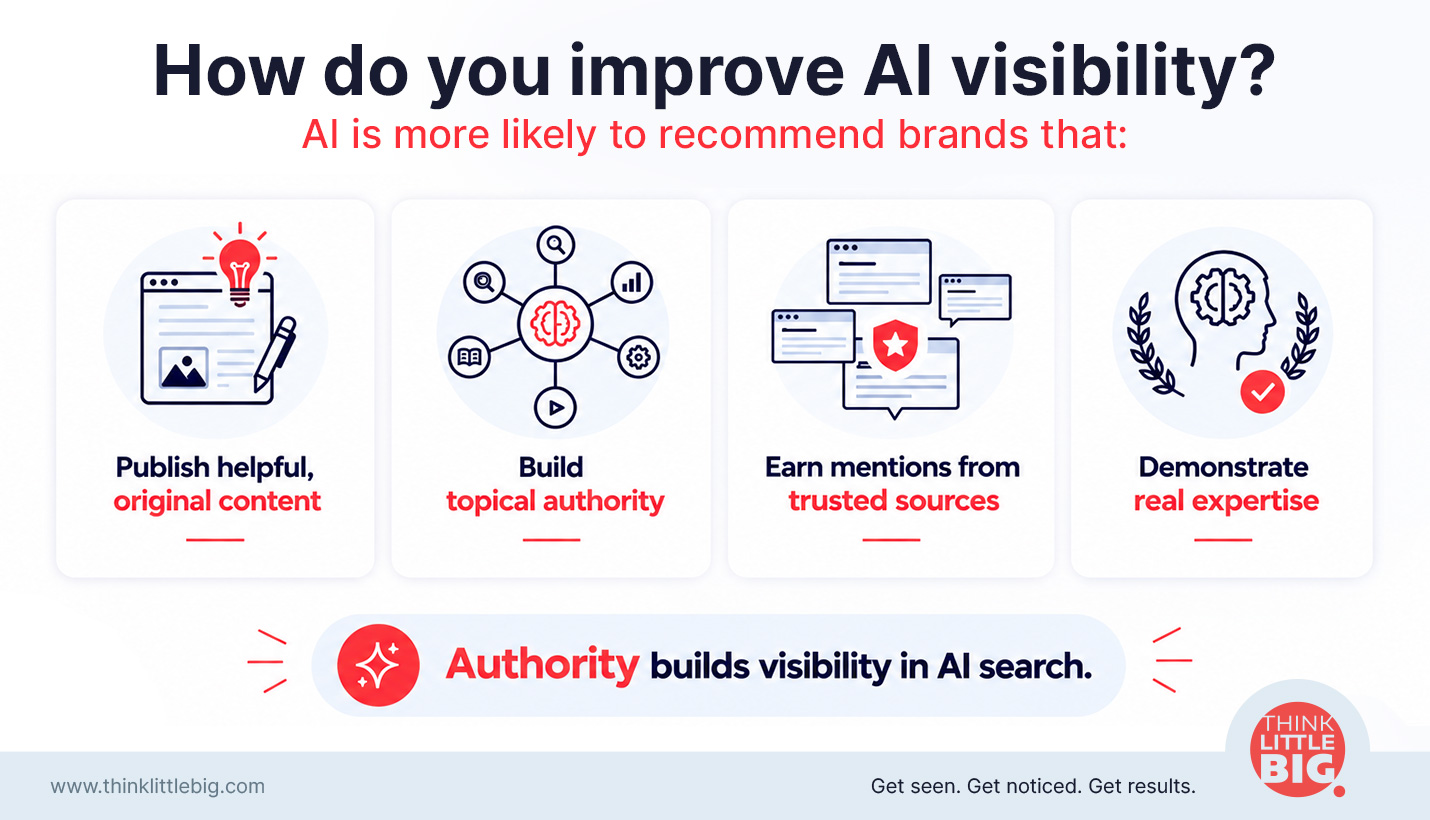
Most of what drives AI visibility is the same work that has always built brand authority.
AI systems build recommendations using a combination of what they learned during training and, for many platforms, fresh information retrieved from the live web. Different AI products use different retrieval methods, but they all aim to combine existing knowledge with reliable, up-to-date information. That’s why publishing authoritative content today still influences whether your business is recommended tomorrow.
1. Publish original evidence, not just opinions
There’s another pattern emerging as AI search evolves. Systems are more likely to reference content that contributes something genuinely new, rather than simply repeating what’s already available elsewhere.
Original research, customer surveys, benchmark reports, proprietary data, case studies, and first-hand experience all give AI search platforms something distinctive to cite. If ten websites summarise the same topic, but yours includes original findings or evidence, it’s far more likely to stand out.
This aligns with the broader direction of search. Whether it’s Google or AI search tools, businesses that create new knowledge tend to build stronger authority than those that simply repackage existing information.
2. Publish content that helps people make decisions, not content written around keywords.
Content written to rank is increasingly easy to identify, for readers and AI search platforms. Content written to genuinely help someone understand a problem, compare options, or make a decision is the kind of thing AI search platforms cite.
3. Earn coverage in publications that carry real authority in your field.
A mention in a respected trade publication does more for AI visibility than ten pages of self-published content. These systems learn from broad patterns across the web and, in many cases, retrieve information from trusted online sources when generating responses. That’s why earning coverage in authoritative publications can have an outsized impact on visibility.
4. Build a citation footprint across multiple credible sources.
One strong source isn’t enough. AI systems look for patterns across many sources. A brand mentioned consistently across publications, review platforms, industry forums, and expert roundups builds a pattern the AI recognises.
5. Develop a public track record the AI can find and verify.
Case studies, published data, named clients, specific outcomes. The more concrete and verifiable your track record is across the web, the stronger the association the AI builds between your brand and your area of expertise.
Google’s E-E-A-T framework, Experience, Expertise, Authoritativeness, Trustworthiness, has pointed at this for years. The signals that earned trust with search algorithms are the same signals that build presence in AI training data.
Mentions matter more than links
Traditional SEO has relied heavily on backlinks. AI search appears to place greater emphasis on broad brand recognition and consistent mentions across trusted sources, alongside traditional authority signals.
- Get into trade publications: Coverage in respected industry media builds the kind of multi-source presence AI models recognise and draw from.
- Appear in comparisons and roundups: Features in industry comparisons and citations in expert roundups reinforce the association between your brand and your topic area.
- Don’t ignore community platforms: Research from BrightEdge found Reddit among the top cited sources for AI responses. These systems pull from wherever credible, relevant information exists.
Your PR work and your content work are pointing at the same outcome in AI search. If those functions are running independently, they’re leaving something on the table.
How AI systems understand your brand
AI models map the web through entities: organisations, people, products, concepts, and how they relate to each other. You want your brand clearly understood as a recognised entity in your specific category.
- Be unambiguous on your website:
- State clearly what you do, who you serve, and what space you operate in. Vague positioning creates vague associations.
- Keep your Google Business Profile and structured data current: These are important signals that help search engines and AI systems understand your business.
- Be consistent across third-party sources: Conflicting descriptions across different platforms create ambiguity. Consistent information builds clear association.
- Strengthen author bios: Named authors with clear credentials are a trust signal for both readers and AI search platforms.
SEO still matters
Many AI tools, including Google’s AI Overviews, use retrieval-augmented generation. They pull from live web sources when forming responses. Content that ranks well in traditional search gets retrieved more, and getting retrieved more means getting cited more.
Semrush research found that over three quarters of AI Overview citations also appear in Google’s top ten organic results. Organic search performance and AI visibility are not separate problems. They feed each other.
- Keep your technical foundations strong: Site speed, crawlability, indexation. If AI systems can’t access your content, they can’t cite it.
- Invest in content depth: Thin content doesn’t rank in traditional search and doesn’t get cited in AI search. These are the same problems.
- Build authoritative links: Link authority still feeds into the credibility signals AI search platforms draw on.
On AI ranking tools
Tools that claim to track your AI ranking position deserve scrutiny.
- Ask how they define a ranking position: Every AI response is different. A single position number without context tells you very little.
- Ask how many times each prompt is run: One run produces one data point. That’s not a ranking. It’s a single observation.
- Ask whether the methodology is published: Legitimate measurement approaches can be reviewed and critiqued. Opaque tools offering precise numbers should be treated with caution.
Tracking visibility percentage across a large volume of varied prompts is the legitimate version of this. A tool reporting a fixed ranking position without explaining the methodology underneath it is giving you a number that means very little. That budget would likely do more work invested in content, earned media, and technical SEO.
What to actually do
- Audit your content: Is it built to help people make decisions, or is it built around keywords? Either answer has direct implications for how AI systems treat it.
- Track your external mentions: How often does your brand appear in credible third-party sources? Trade publications, industry blogs, comparison sites, analyst reports. That footprint is one of the most direct inputs into AI visibility.
- Clean up your entity signals: Make sure your brand’s core information is consistent across your website, your Google Business Profile, and your structured data.
- Keep investing in organic search: It directly feeds AI retrieval. These aren’t competing priorities.
- Test your own visibility: Run relevant prompts monthly across ChatGPT, Perplexity, and Google’s AI Overviews. Document the results. Track the pattern.
The idea of ranking first in AI search comes from a mental model built around Google over two decades. First position meant clicks. Clicks meant growth. That logic made sense for that system. It doesn’t transfer.
There’s no stable first position in AI search. No fixed list. The brand that leads one response may not appear in the next. What’s real is how consistently your brand comes up when AI systems answer questions in your category. That’s what’s worth building toward.
It takes time. It compounds over months and years, not days or weeks. The brands that succeed in AI search won’t be the ones that somehow crack a secret algorithm. They’ll be the ones that consistently demonstrate expertise, publish genuinely useful content, earn credibility across trusted sources, and become recognised authorities in their field. AI hasn’t replaced those fundamentals. If anything, it has made them even more important.
Building that kind of authority doesn’t happen overnight, but it does compound over time. At Think Little Big, we help businesses improve both traditional search performance and long-term AI visibility. If you’d like to discuss what that looks like for your business, we’d love to chat. Get in touch with us today!